Small bronze restoration

How To Care For Bronze Statues In Your Home

Caring for bronze sculpture in your home is much easier than those in your garden. Indoor bronzes have an easy time of it compared to their large companions outdoors. They are sheltered from the urban air and ever-changing weather, but their environment still has an impact on them and if you want to keep your small bronzes as stable as possible then consider these seven tips.

1: Dust Regularly – Don’t be frightened to touch a bronze just because it’s an artwork. If you use a dry micro-fibre cloth or a soft brush, you’ll be doing a lot of good rather than harm. Caring for bronze involves removing dirt and grime. This prevents reactions between the pollutants in dust and the metal’s surface. We all hate more housework, but preventing corrosion is always better than curing it.

2: At least once a year, give the statue a thorough clean. Use white spirit to remove dirt and grime – I use a cotton rag to apply it. Then put a protective coating in place – this is one of the best ways of protecting a bronze’s surface. Outdoor pollutants from traffic do infiltrate buildings. Over time, they will corrode your bronzes (Grontoft et al, 2016). Rub on microcrystalline wax and burnish with a bristle brush or cotton rag as you might your shoes. It will improve the bronze’s lustre and retard surface change.

3: Move bronze away from wood. Internal materials like wooden floorboards and furniture emit acidic gases such as acetic or formic acid. These will damage your bronzes particularly if airflow is static and if the temperature of a room is likely to fluctuate widely. To care for your bronze sculpture, consider where you locate your small bronzes. Try not to display them in sealed cabinets made from materials containing hard and soft woods or plywood (Gibson, 2010)


You can buy our latest book, Wax On Wax Off – How To Care For Bronze Sculpture online or order in book shops and libraries. It provides in depth information about how to care for your statues at home including maintenance routines, tools and FAQs.

Care For Bronze Statues by Not Touching Them

4: Avoid handling your bronzes. If possible, lift your bronzes with a clean cloth rather than touch them directly. Sweat from the hands is acidic and will corrode metal. Wax is only a thin barrier layer.

5: If you are storing a small bronze rather than displaying it. Ensure that the packaging materials are suitable. Do not wrap bronzes directly in bubble wrap or plastic. Houses tend to have poor humidity controls and though it might surprise you – bronzes do hold water. When they heat up that water will evaporate and if you’ve trapped it in plastic – you’ll get corrosion activity beneath the plastic.

6: If you accidentally spill red wine, tea, coke or even water on your bronze – then run for a cloth! Just because it’s not a textile that stains – don’t assume that the liquid won’t do any harm. If you whip it off quickly, then harm is averted. If you leave it to dry out, the metal is likely to etch in the perfect shape of the splash or spill. A little warm water on a clean cloth as dry as possible will enable you to remove the liquid and save your bronze surface. Don’t forget to dry your bronze after you’ve washed it though – that’s very important.


7: Admire your bronze often – don’t ignore it. If you keep an eye on your sculpture,  you will notice if there is any change occurring. If rapid change occurs within a short period, then the chances are it is being exposed to something. Be mindful, and you could prevent a bigger conservation problem.

Cleaning Bronze Statues

REMOVING DIRT AND GRIME IS THE FIRST STEP IN THE PROCESS OF CLEANING A BRONZE SCULPTURE

Bronze cleaning is an essential process that should be carried out as part of a preventive conservation regime. In simple terms, this just means as a way to prevent the kind of decline that bronzes are prone to in outdoor, and often indoor, environments. 

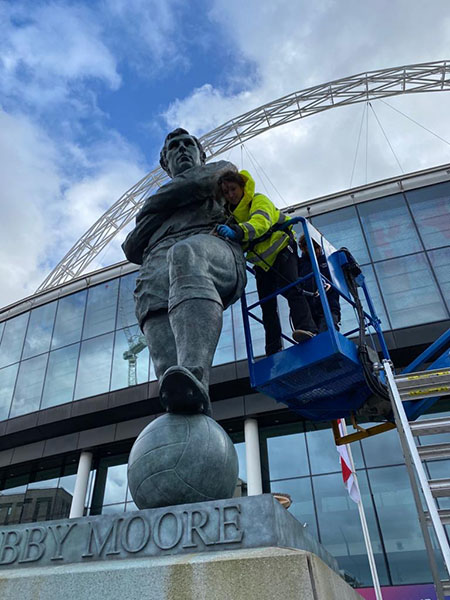
All bronze statues should have a maintenance clean periodically. This is carried out by hand and not only involves the removal of dirt, grease, grime and guano but is followed up by the application of a protective coating.  This is more than just cleaning but is absolutely essential for the long term care of a bronze sculpture.

Keeping a bronze statue clean is not only about presenting the statue as cared for, it is about lowering the rate of breakdown of the bronze’s protective coating.  Cleaning bronze statues helps to keep the surface protection viable for longer. 


Cleaning bronze statues

OTHER TYPES OF STATUE CLEANING

Apart from maintenance cleaning, sometimes it is necessary to fully remove an existing protective coating. This can also be termed cleaning, but does not typically happen during a maintenance clean. This is more common during restoration work when a protective coating has failed or a coating has been added, at some point in the statue’s history, to disguise the true condition of a bronze’s surface.  Methods such as cleaning with super-heated water or solvent cleaning are used in this type of cleaning. 


Another valable technique is spot-cleaning. That is a dry cleaning system where detritus, dirt, cobwebs and guano are brushed away gently between maintenance cleans so that the statue is presented as cared for between its more thorough cleans. It also prevents the breakdown of the protective coating in localised areas. 

Bronze Behaving Badly book 3D cover

Our book, Bronze Behaving Badly, covers this topic and many others relating to sculpture conservation in more depth. Buy it online or order in bookshops or libraries. 

WHAT CLEANING BRONZE STATUES DOES NOT MEAN

Cleaning a bronze statue does not mean cleaning the statue so that it looks  as it did when it was first created. The word cleaning means that you are cleaning the bronze in order to enhance its stability not restoring the bronze surface.

Cleaning bronze statues does not mean removing the patina on a statue’s surface – contrary to what some may lead you to believe on YouTube. It never involves polishing them up so that they are gleaming (with some brasso and elbow grease). It should be about preserving the bronze’s surface, not removing it. 

Cleaning bronze statues should never involve applying acids or alkalis to the surface of a bronze – even if it is natural (no lemons or vinegar!) 

WHAT CLEANING BRONZE STATUES DOES MEAN

When dirt and pollutants settle on a bronze but are not removed, they will compromise the protective coating and prevent it working effectively. The result will be that corrosion forms and the surface changes permanently meaning no amount of cleaning can change it back: restoration is the only option. 

We use cookies to ensure that we give you the best experience on our website.